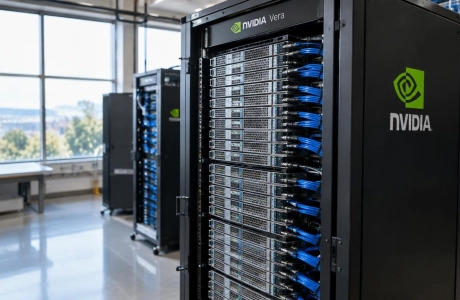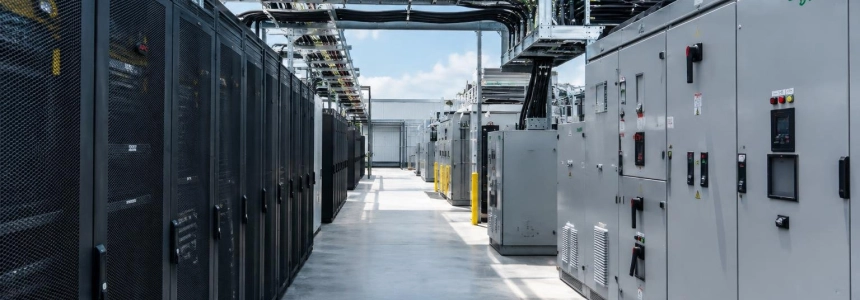
Data centers could add another 120 GW of capacity before 2030, with 75% of that expansion dedicated to artificial intelligence. The figure, reported by Tom’s Hardware based on the International Energy Agency’s (IEA) World Energy Outlook 2026, points to an expansion that will test power grids and siting decisions, not just chip availability.
The projection describes capacity, not a direct measurement of each facility’s actual consumption. But the order of magnitude helps put the shift in perspective: the IEA puts the current capacity of all types of data centers worldwide at 120 GW and expects another 120 GW to be completed before the end of the decade. If that expansion materializes, aggregate capacity would double.
From the race for chips to the race for electricity
The expansion is not limited to completed buildings. Tom’s Hardware reports that the IEA is tracking 93 large “AI factories” under construction or being expanded using satellite imagery. Their combined capacity is said to have risen from less than 2 GW to 17 GW in two years, and could reach 50 GW when all those projects are complete.
Tom’s Hardware compares those 50 GW with Great Britain’s electricity demand. This does not mean those facilities will consume that amount at all times, nor does the comparison by itself describe the impact on any particular grid: it serves to illustrate the projected scale of a group of projects. Meanwhile, the estimate of an additional 120 GW of data center capacity includes facilities of various types, not just AI factories.
The associated investment is also substantial: Tom’s Hardware’s headline links the projection to $4 trillion in spending. The figure appears in that headline, while the article itself focuses on the IEA’s capacity projections. In any case, the practical takeaway is that buying accelerators and building data halls is no longer enough to bring computing capacity online: electricity has to be delivered on time.
Jason Eichenholz, founder and CEO of Relativity Networks, described this shift in a conversation with SD Times: “The AI environment is shifting from a race to acquire chips to a race to deliver productive computing capacity”. His argument is that useful capacity depends on more than hardware: available electricity, connection timelines, location, networks, and acceptance by nearby communities all matter.
“The AI environment is shifting from a race to acquire chips to a race to deliver productive computing capacity”
— Jason Eichenholz, founder and CEO of Relativity Networks
This shift changes how projects are evaluated. A site that looks attractive on paper may be constrained by grid capacity, water availability for the facilities, permits, cooling, or fiber connections. For a company looking to expand its computing capacity, the question is no longer just how many GPUs it can buy: it is also where it will be able to operate them and when.
Location becomes part of the design
Eichenholz told SD Times that the grid and substation upgrades needed for facilities of 500 megawatts or several gigawatts can take four to six years. This is an estimate given in the interview, not a universal timeline for every project. Even so, it shows why securing an electricity connection can move at a different pace from acquiring equipment.
This mismatch forces companies to incorporate local infrastructure into their planning. SD Times reports that they need to consider the power grid and substations, as well as water, construction, permits, network connections, and the impact on residents. A region with available land is not automatically suitable if it lacks power or if construction and operations face opposition.
The consequence for companies developing AI services is indirect but tangible: infrastructure location can determine where the capacity they need is deployed and how computing resources are connected. Eichenholz suggests that facilities can be distributed across different locations rather than concentrating all demand on a single campus. That distribution, in turn, requires connecting resources that need to work in coordination.
That is why fiber appears in the interview as part of the infrastructure solution, not an add-on. Eichenholz distinguishes three scales of connectivity: within a data center, between facilities or campuses, and between regions, as well as long-distance terrestrial and submarine links. If accelerators and other processors are distributed geographically, the network must let them exchange data with the latency and reliability required for collaborative workloads.
More infrastructure, but also more local friction
Data center growth could create opportunities for investment in energy and connectivity. In SD Times, Eichenholz mentioned investments by technology companies, cloud operators, and data center companies in next-generation modular reactors, clean energy, solar power, and storage. He presented these investments as a response to opportunities that, he said, were not previously economically viable; the interview provides no figures to measure their scale.
The trade-off is that the costs of expansion and its effects can also fall on the surrounding area. The conversation with SD Times lists the use of large tracts of land, noise, and concerns about possible increases in electricity bills. How these costs and benefits are distributed remains an open question: building more capacity does not by itself determine who pays for the construction or how communities are compensated.
A Pew Research Center survey, cited by Electronics Weekly, reflects this unease in the United States. 54% of respondents said data centers are mostly bad for the environment, up from 39% in January; 50% expected them to raise utility bills, and 60% would be uncomfortable with a new one in their area.
| Perception reported in the survey | Result cited by Electronics Weekly |
|---|---|
| Data centers are mostly bad for the environment | 54%, up from 39% in January |
| Concern about higher household bills | 50% |
| Discomfort with a new data center in the area | 60% |
| Expectation of a mostly negative effect on local employment | 24%, up from 15% in January |
| Expectation of a mostly negative effect on local tax revenue | 21%, up from 12% in January |
Electronics Weekly also notes that 49% were concerned about the impact on the quality of life of people living near a data center. For employment and local tax revenue, two potential benefits of these facilities, the reported negative perception increased compared with January. The percentages describe responses to that survey in the United States; they cannot be extrapolated to public opinion in other countries.
For companies, this opposition can become another factor in site selection and scheduling, alongside energy and connections. Eichenholz argued that operators and municipalities can agree on local benefits, such as funding for fire stations, schools, training, and jobs. His proposal depends on both sides reaching an agreement; it does not mean those benefits are guaranteed for every project.
What changes for companies and development teams
The immediate implication for companies training or serving models is that computing availability could increasingly depend on geography. If a campus does not have enough power, distributing facilities requires links capable of keeping resources connected. According to Eichenholz, the issue is no longer just how much bandwidth a fiber offers, but also the speed, reliability, and economics of moving data between resources.
This brings infrastructure decisions forward, before production deployment: choosing computing services requires considering where they are hosted, what connectivity links them, and what local constraints could affect their growth. The SD Times interview does not quantify how much costs or application performance might change. It does explain why location and networking are now part of planning, alongside processors and electricity.
For operators, the challenge is coordinating timelines that do not move at the same pace. An AI demand forecast may lead to hardware orders, but a substation or grid upgrade can take years. Permits, water, construction, and community acceptance are additional factors. The business risk is not just running short of chips: it is also investing in equipment before a site is ready to power and connect it.
The IEA projection and the 93 factories tracked by satellite do not guarantee that every project will be completed or operate at full capacity. They do show that the scale announced for this decade makes it necessary to treat energy and connectivity as part of the same challenge as computing. For every new campus, the practical question will be whether the grid can supply it with power on schedule and whether the community will accept its construction there.
Sources: Tom's Hardware, SD Times, electronicsweekly.com