Claude Code, Anthropic's coding assistant, picked up a new rule about video games this week. It will still help you build original games, games in a genre and games made from your own designs and assets, but it should no longer recreate a specific existing game, even if the project is renamed or called original. The instruction started reaching sessions around 27 October, with no announcement and no changelog entry, and Anthropic has yet to explain how far it goes.
It came to light through a user called chasm, who posted a screenshot of the text on X on 30 October. Within hours it had reached the PC recompilation and native-port scene, where Claude has become an everyday tool. The question there is not what the rule says, but how a model will apply it when the job is not copying a game but moving it to another machine.
What the rule says
It is two sentences added to the system instructions every session starts with:
Do build original games, games in a genre, and games from the user's own designs and assets.
Don't build a recreation of a specific existing game, even if it is renamed or called original.
We use Claude Code every day at ma-no.org, so we checked: in a session today, 30 October, running Opus 5.5 in the VS Code extension, both sentences appear word for word in the system instructions.
Outside Claude Code there is no trace of it. Anthropic's usage policy, whose new version takes effect on 12 November, does not mention video games. What it has long prohibited is using Claude to "infringe, misappropriate, or violate the intellectual property rights of a third party". The new rule turns that general ban into a test the model can apply without playing lawyer: if the game exists, don't recreate it.
How it arrives: the remote channel found in May
The instruction is not part of the program you install. Anthropic sends it from its servers through an internal flag called tengu_heron_brook, and that channel is not new. In May, with version 2.1.150, a user opened issue #62061 on GitHub after finding that Claude Code could fetch a string over the network and drop it straight into its instructions; the changelog had summed it up as "internal infrastructure improvements". The reply in the thread was that it is used to test system prompt changes and catch regressions before rolling them out to everyone. In July, issue #80988 documented that the same section carried a different default order on Opus 5 models (don't launch subagents unless the user asks) and that there was no way to switch it off in the settings.
That explains a good part of the frustration. For people who pay for Claude Code and use it on long projects, the problem is not just this rule: it is that the tool's behaviour can change overnight without notice. People on X are arguing about whether toggling experimental feature flags removes it, but there is no evidence that doing so gets rid of this particular instruction.
Why now: ports in hours, and studios afraid of clones
Anthropic has not given a reason, but the last few months offer clues. In July, Ammaar Reshi, product and design lead for Google AI Studio, brought Command & Conquer: Generals Zero Hour to iPhone and iPad with Claude Code and Fable 5: the first build was ready in about 40 minutes, and the rest took a few hours of debugging. That port starts from the source code EA released under the GPL in 2025, and each player supplies the game's assets. On 9 October, Kotaku covered browser ports of Halo: Combat Evolved, GTA: Vice City and The Simpsons: Hit & Run, crediting Opus 5.5 with making decompilation easy. In mid-October a native PC port of the Switch Link's Awakening appeared on GitHub; its author says Claude was used to decompile the game and write most of the code.
On the other side are the studios. Digital Sun, the Valencia-based developer of Moonlighter, swapped the open Steam playtest of ReVamp for a smaller one on Discord, starting on 29 October, for fear that someone would take the test build apart with AI and publish a clone before launch. Against that backdrop, a tool that can copy a game in an afternoon is an obvious legal risk for the company selling it.
Recreating is not decompiling, recompiling or porting
The rule talks about "recreating", while the port scene works with other techniques. The difference matters:
- Recreating means writing a game from scratch that imitates another one: its mechanics, levels and characters. It is the only thing the rule explicitly forbids.
- Decompiling means rebuilding readable source code from the original executable. In the strictest projects, that code compiles back to exactly the same bytes. Graphics, music and text are not part of the repository.
- Static recompilation translates the console's machine code into code that runs natively on a PC, with no emulator. That is what N64Recomp did for Zelda 64: Recompiled in 2024, and the player provides their own copy of the game.
- Porting means taking the game, from decompiled or released source, to another platform: swapping DirectX for Metal, reworking audio, controls or resolution.
flowchart TB
    J["Original game: supplied by the player"] --> D["Decompilation: rebuilt source code"]
    J --> R["Static recompilation: native PC code"]
    D --> P["Port: another platform or graphics API"]
    R --> P
    C["New code imitating a specific game"] --> X["Recreation"]
    X -->|"explicitly forbidden"| Q{"Claude Code rule"}
    P -.->|"not addressed"| Q
The wording only rules out recreation. The trouble is that a model reading "don't recreate an existing game" may decide that porting Zelda to PC is recreating it, and there is no public guidance on where Anthropic draws the line. It doesn't help that these projects live in a grey area: they don't ship the game's assets, but decompiled code is derived from the original, and publishers tolerate or challenge it case by case. Not all the pushback comes from outside, either. The author of decomp.wtf, a tool that let AI agents decompile games the user owns, has archived the project because, in their words, much of the decompilation community is against doing it this way, and many projects don't accept AI-written contributions.
The first casualty: a commission stopped halfway
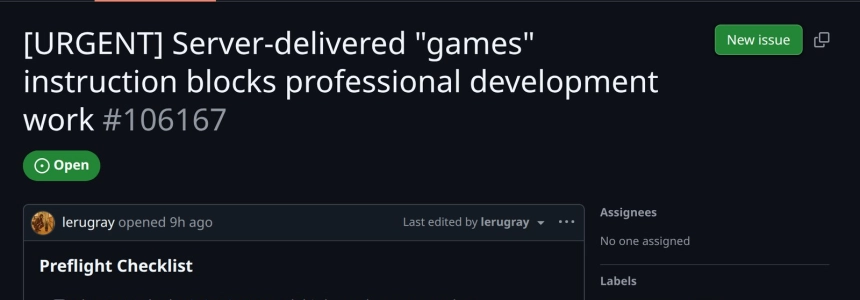
The first documented case reached the official Claude Code repository on 30 October. The owner of Conflict Simulations LLC, a small company that builds digital modules of board wargames on commission, opened issue #106167 flagged as urgent: sessions that had been doing this work for months now refused to continue, citing the new instruction.
The details matter. The first version of the issue described the work as "licensed"; a few hours later the author corrected it: there is no licence from the publishers. The company makes personalised builds for clients who prove they own the game and hand over the material themselves, for their own use and never distributed. The author asks for three things: that the rule target actual infringement (copying protected code, art or text) rather than games as a category; a verification path for professionals, like the one Anthropic already offers security researchers; and that changes of this size be listed in the changelog.
An update added the most telling detail: the work kept going after 27 October, and the refusals began once the author asked Claude to check whether the new rule affected them. Since then, sessions on those repositories turn it down. That fits what the rule actually is: not a filter that blocks keywords, but one more sentence in the instructions, which the model interprets based on the context of each conversation. The automated support assistant replied, on two different accounts, that the policy "applies to all customers without exception". At the time of writing, the issue is still open with no reply from the Claude Code team.
What changes if you build games with Claude
- Your own games, prototypes, game jams or games in a genre (a roguelike, a platformer, a metroidvania): the rule explicitly allows them.
- Mods built with a game's official tools, level editors or utilities: the rule doesn't mention them, and nobody has confirmed how they are treated.
- Decompilations, recompilations and ports of commercial games: this is where refusals are to be expected, and the Conflict Simulations case suggests they depend heavily on how the work is framed.
- Work done with the rights holder's permission: there is no exemption path today. If it happens to you, the useful move is to document it on GitHub as this developer did, since that is where Anthropic can refine the rule.
Some users are already announcing on X that they will move to other models, while others welcome fewer AI-made clones. What nobody knows is whether the rule will stay as it is, be narrowed or disappear: it arrived unannounced, through a channel that lets Anthropic change it at any moment, and it can leave the same way.
Sources: PC Master Race Latinoamérica, chasm on X, GitHub #106167, #62061 and #80988, Anthropic usage policy, The Decoder, EA on GitHub, Kotaku, TechSpot, PC Gamer, decomp.wtf