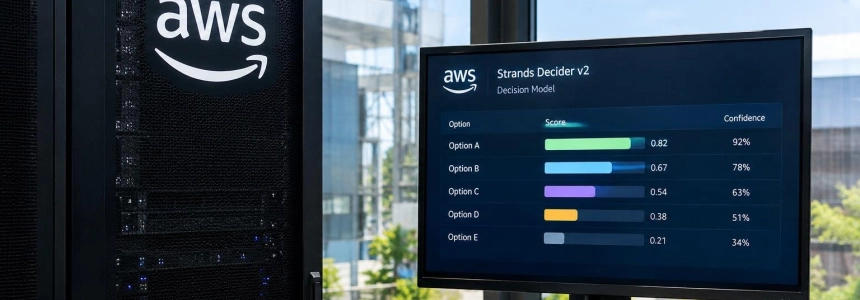
AWS has released five Strands Decider v2 models based on Gemma 4, ranging from E2B to 31B, to handle specific decisions within AI agents. Rather than drafting a response, each model chooses among the options it receives and returns a probability for each one; the weights are available on Hugging Face, and the project is distributed under the Apache 2.0 license.
A choice among options, not generated text
Strands Decider is designed for decisions with a set of answers known in advance: choosing a tool, routing a request, checking whether a response is safe, or assigning a ticket to a team. The model receives the state, the question, and the alternatives, then calculates a probability for each option in one pass. This lets the agent use the result without interpreting a prose response.
Version 2 supports up to 255 options per question, according to VentureBeat. AWS says it also expands the types of inputs it can handle: it processes text, images, and video in its evaluations, and its training was geared toward long inputs, such as agent execution logs. The model documentation specifies a context of 32,768 tokens and image input.
The family includes five sizes, from E2B to 31B. AWS publishes scores across five evaluation sets, along with the median latency measured on an H100 for a JevBench question. The scores in the table are out of 100.
| v2 model | Decision Index 0.3 | JevBench | OpenDecisions | DecisionPivot | BEV | GPU listed | Median latency |
|---|---|---|---|---|---|---|---|
| E2B-gemma4-v2-2611 | 57,1 | 87,4 | 77,7 | 23,3 | 74,0 | 24 GB | 62 ms |
| E4B-gemma4-v2-2611 | 63,2 | 88,3 | 83,9 | 45,2 | 78,9 | 40 GB | 78 ms |
| 12B-gemma4-v2-2611 | 64,1 | 92,2 | 85,7 | 58,9 | 79,0 | 48 GB | 80 ms |
| 26B-A4B-gemma4-v2-2611 | 69,0 | 92,6 | 88,6 | 69,2 | 81,4 | 80 GB | 86 ms |
| 31B-gemma4-v2-2611 | 71,5 | 93,1 | 92,2 | 84,3 | 84,5 | 80 GB | 99 ms |
The Strands documentation defines Decision Index 0.3 as a public test of 41 tasks across five areas; JevBench measures accuracy on 231 items. OpenDecisions evaluates everyday decisions based on response quality and calibration; DecisionPivot measures accuracy on pairs that differ in one decisive detail, and BEV covers choices, yes/no answers, and ranked scores across 18 domains.
An architecture that takes advantage of shared context
The central technical change is how the model processes the situation. Strands Decider v1 used causal attention, which reads in one direction, and an added layer to select the answer. In v2, attention is bidirectional: the shared state can be read with both what comes before and what comes after in mind. Each question then queries that representation and scores its options.
This makes it possible to ask multiple questions about the same state without processing the entire context again each time: additional questions require only their own tokens. The new bidirectional reading is intended to help in cases where a detail in a long conversation changes the decision. On DecisionPivot, AWS reports a score of 84.3 for the 31B v2 model, compared with 23.2 for the 26B-A4B v1. These are not models of the same size, a difference VentureBeat notes when comparing the results.
Training also grew: AWS describes 17.48 million decision examples, compared with 136,000 in v1. The data combines datasets with human labels and open licenses, synthetic examples generated from task descriptions—not from test items—and problems with answers calculated using programs. The company trained each size for one epoch, fine-tuned the weights with rank-64 LoRA, and calibrated probabilities using held-out questions.
Across six public text benchmarks, AWS says the 31B v2 model averages 82.1 points, compared with 70.0 for v1. For E4B, the average rises from 62.7 to 74.4. On the same six tests, the 31B model's expected calibration error falls from 0.062 in v1 to 0.027 in v2; the lower the error, the more closely the probabilities match how often the model is correct.
Cost and confidence as routing criteria
Calibration allows an agent to act with a small model when confidence exceeds a threshold and send uncertain cases to a larger model or a person. In a reading test, AWS sent half of the Llama-2-13B responses that v2 had lower confidence in to Llama-2-70B. According to the company, this recovered between 94% and 99% of the larger model's improvement; sending a randomly selected half recovered 50%.
In another test, Decider routed requests between Claude Haiku 5.5 and Claude Sonnet 5.5 for customer support and application automation tasks. AWS says the system solved 94% of the tasks Sonnet completed on its own, at 44% of its cost, and outperformed a random split at the same cost by 11.7 tasks per 100. AWS did not specify which Decider model it used in that experiment.
VentureBeat also reports a test on LLMRouterBench, where routing between DeepSeek V3 and Gemini 2.5 Pro achieved 88% of Gemini's accuracy at 18% of its cost, according to AWS. The company says that result matched the best open-source router it tested.
The precedent of Amazon's tickets
AWS had already applied the first version to ticket classification in one of Amazon's largest internal systems. There, engineers replaced Claude Sonnet 4.6 with the v1 E4B model: each ticket was assigned to one of 20 labels or to none. AWS reported a 98% reduction in labeling costs and calls that were 78% faster.
VentureBeat provides the figures from that test: average time per call fell from 4,215 to 897 milliseconds, and tokens per ticket dropped from 6,724 to 2,010. Based on published list prices, AWS estimated that the cost fell from about $22,200 to about $500 per million tickets. The $500 estimate depends on using SageMaker instances. Before the change, the team ran both models on real traffic behind a three-way switch in AWS AppConfig; reverting the configuration took 45 seconds. AWS attributes these results to its own test.
“I ask one question: can you write down the possible answers before the request arrives? If you can, it's a decision and the Decider should take it,”
— Fabio Nonato de Paula, principal applied scientist at AWS, according to VentureBeat
Nonato de Paula's proposed practical test is to check whether the possible answers can be listed before a request arrives. If the task requires writing an explanation, creating a new response, or considering an option that was not anticipated, a generative model is the right choice; both types of model can also work together.
Open weights and deployment
The five v2 models are available on Hugging Face, and the Strands Decider repository adds support for the new version, along with the training code and evaluations. AWS says they can be served on a machine of your own with CUDA, on a Mac, or on a CPU; they can also be deployed to an Amazon SageMaker AI endpoint or AWS Lambda. For Lambda, the repository describes a configuration that runs a quantized model on an arm64 CPU and keeps no resources active between requests.
The v1 family remains available, according to the documentation. For v2, AWS recommends E2B when the smallest size is desired; E4B for a 40 GB GPU, 12B for a 48 GB GPU, and 26B-A4B for an 80 GB GPU when asking many questions about the same state. The company presents 31B as the most accurate option.
The release follows the launch of v1 on October 1, according to VentureBeat. AWS links the changes in this edition to feedback it received and to the need to handle cases where a single detail in a long input changes the answer. The company invites users to test the models on real decisions and share results to help guide which tasks it trains for next.
Sources: Strands Agents, Strands Agents, Venturebeat, SiliconANGLE