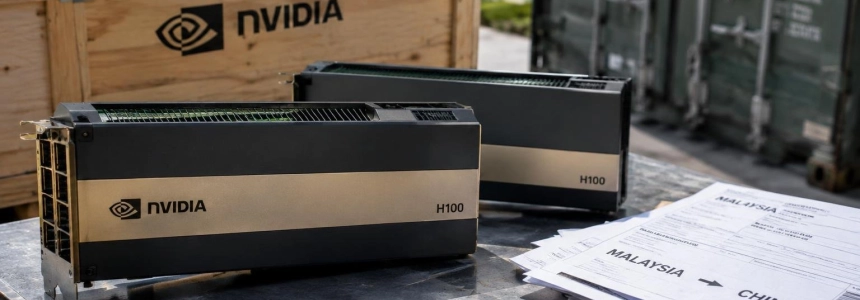
The Financial Times places the company in a network of businesses that allegedly moved Nvidia chips to China and links it to former executive Alice Huang, video game moguls and a figure whom U.S. authorities have linked to Prince Group.
The reports by the FT and The New York Times paint two parts of the same story: trade routes for restricted chips and financial ties to companies associated with Huang’s family. Neither newspaper establishes that the Chinese military used the computing power financed with those funds. TNW said it had not independently verified the reports.
From Inspur to Megaspeed
FT journalists Zijing Wu and Haohsiang Ko reconstructed the network from hundreds of corporate documents and more than a dozen sources. According to their investigation, the companies involved moved billions of dollars’ worth of Nvidia chips to China, although some may not have known the full picture.
The route allegedly began with Inspur, one of Nvidia’s largest server partners in China. The United States added Inspur to its Entity List in March 2023, but not its U.S. subsidiary, which is partly owned by the Chinese company. Renamed Aivres, the unit continued doing business with Nvidia.
There were questions within Nvidia about whether Aivres should be considered a partner, a person with direct knowledge told the FT. The company concluded that the firm complied with compliance rules and export controls. Later, some Chinese Inspur customers turned to Century Huatong, an online gaming group that had also entered the data center business.
According to people familiar with the plan cited by the FT, the response was to use an offshore shell company presented as a “neocloud.” That structure became Megaspeed, with Huang as its public face. Megaspeed was allegedly part of the network described by the newspaper.
Megaspeed emerged from 7Road’s Singapore division, a gaming company backed by both Huang and Century Huatong.
The role attributed to Prince Group
The final leg allegedly involved bringing the chips into China. People familiar with the matter told the FT that Hu Xiaowei handled at least part of that role. U.S. authorities describe Hu as Prince Group’s “second-in-command” and have designated the group a transnational criminal organization. Hu was arrested in Japan during the summer, according to the report.
A spokesperson for the Prince group of companies said Hu had never worked for the company and called the U.S. accusations unfounded. The FT said it was unable to reach Hu.
Nvidia said it added Megaspeed and a subsidiary to its blocked list in 2025 and also restricted sales to Aivres. Megaspeed has maintained that it operates legally and that Huang left the company in August 2025. Tencent, which owns 10.1% of Century Huatong, said it was unaware of those activities. The FT said it found no evidence that Tencent or Alibaba participated in them.
Huang is a former Megaspeed executive and a central figure in the Nvidia case. In October, The New York Times first reported that U.S. officials suspected she was working for Chinese intelligence and described an espionage scheme. Beijing rejected the accusation and called it defamation. Jensen Huang left his post as Nvidia CEO on November 12, after admitting to an extramarital relationship with Alice Huang; they are not related.
The trail of $3.6 billion
A day before the FT report, The New York Times published another article based on a confidential analysis by Strider Technologies, an intelligence company founded by former intelligence agency personnel. The analysis estimated that about $3.6 billion in Chinese state funds passed through companies linked to Huang’s relatives or associates. The money funded projects that included data centers equipped with Nvidia chips, and the Times said it independently confirmed many of the connections.
The newspaper cautioned that most of the connections were indirect and that it was unclear whether the Chinese military used the computing capacity. It had previously reported that Alibaba, a backer of Megaspeed, co-founded a laboratory connected to the military sphere. The financial link described by the Times does not in itself prove that Megaspeed’s equipment ended up in military facilities.
“Follow the money and, too often, you find the P.L.A. at the end of it,”
— Greg Levesque, director ejecutivo de Strider Technologies
Both newspapers mention Century Litong, a Shanghai company. The FT describes Century Longteng as a company established by Century Huatong and a vehicle controlled by Huang and her sister. The Times identifies the sister’s company. According to people familiar with the deals who spoke to the FT, Century Litong was a major distributor of Nvidia chips smuggled into China; The Information had previously reported on its role.
The Times added that Jiangsu Lettall Electronic, which owns Century Litong, also controls a Chinese manufacturer of components for radars and missiles. This is a corporate link, not proof that Nvidia chips were used to manufacture those systems. Century Litong denies having dealings with Huang.
H200 licenses and Nvidia’s response
License records published Thursday by a House committee show that Nvidia applied for permission to sell more than 40,000 H200 chips to Century Litong’s Hong Kong unit. An Nvidia spokesperson told the Times that although it obtained some licenses, the company had already stopped H200 shipments to China and had not shipped and would not ship those chips to that company.
Information about applications and licenses does not amount to a delivery: Nvidia denied shipping units to Century Litong. The episode highlights the difference between applying for export authorization, receiving permits and completing a sale. The number of licenses the company received and how many units they may have covered were not specified.
Nvidia shares have meanwhile recorded their worst losing streak since 2008, according to TNW’s report. The coverage also brings together responses from the companies mentioned: Nvidia points to its restrictions on Megaspeed and Aivres; Megaspeed defends the legality of its business; Tencent says it was unaware of the activities; and Century Litong denies commercial ties to Huang.
The reports leave two specific questions unanswered: whether the capacity financed with Chinese state funds was ever used for military purposes and how much of the network knew where the chips were going. Nvidia says it did not ship H200 chips to Century Litong, while the FT attributes about $4.6 billion in Aivres imports to Speedmatrix through December 2025.
Source: TNW | Nvidia