Genesis AI has closed a $500 million Series A at a $3.5 billion valuation to expand production and deployment of Eno, its general-purpose robot. The startup, founded by Zhou Xian and Théophile Gervet, is betting on hand dexterity and an integrated system of data, software, and hardware, rather than replicating the complete human silhouette.
The round was co-led by Premji Invest, Khosla Ventures, and Eclipse. Participants included Durable Capital Partners, T. Rowe Price Associates, Bpifrance, HSG, NVIDIA, AMD Ventures, Zoom, Samsung Next, and Ericsson. Other investors included former Google CEO Eric Schmidt, Zoom CEO Eric Yuan, Jerry Yang, Xavier Niel, and Zach Kirkhorn, Tesla’s former CFO.
The deal is the biggest financial boost Genesis AI has announced since its founding in 2024. The startup had raised $105 million in a seed round in July 2025; it will now use the new funds to collect more data, train its systems at greater scale, hire specialists, and bring Eno to customers.
A robot that isn’t trying to look human
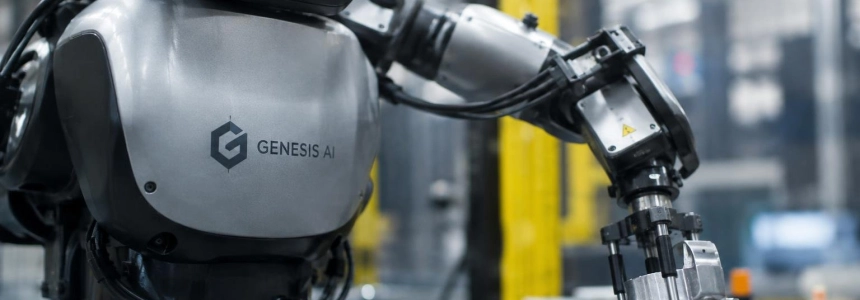
Eno has no legs or head. Genesis AI presents the design as a functional decision: its goal is to prioritize human capabilities—especially object manipulation—rather than outward resemblance to a person. On the company’s website, Eno is presented as a general-purpose robot, and the company invites potential customers to sign up for a waiting list.
The absence of a head also has a practical explanation for Xian. “I don’t understand why robots need a head because… they don’t even have a brain in there”, the CEO told Reuters, according to Xataka. This approach departs from the dominant bet on humanoid robots with bodies and appearances closer to those of people.
“I don’t think we expect or we need another fundamental scientific leap. No, we have all the recipes. It’s just about execution.”
— Zhou Xian, co-founder and CEO of Genesis AI, to TechCrunch
The company describes Eno as the physical component of a strategy that also includes its artificial intelligence model and a simulation platform. In its announcement, it identifies the foundation model as GENE and the virtual environment as Genesis World. The company says the three components feed into one another: data from people trains the model, simulation helps test and improve skills, and the experience of deployed robots provides information for new iterations.
Worker data and sensor-equipped hands
Genesis AI’s central bet is manual dexterity. To gather data on how objects are handled, the startup uses gloves with sensors that, according to TechCrunch, also record force information. More than 100 workers from around the world use those gloves and cameras built into headsets while carrying out their tasks; their actions feed into the company’s training dataset.
The system connects the human hand, the capture glove, and the robotic hand in a correspondence Genesis calls 1:1:1. The company says Eno’s hand closely mimics the proportions of a human hand. Xian linked this fidelity to tasks such as sorting objects and handling cables. Xataka puts the cost of each sensor-equipped glove at around $300.
Data capture is not limited to the gloves. Cameras built into the headsets record the activity of the people wearing them, while Genesis develops its own model and designs the robot. The company generates its data and builds its technology in-house, a vertical integration strategy that, according to its announcement, aims to coordinate hardware, controls, artificial intelligence, and evaluation in a single process.
Simulation is another component of this approach. TechCrunch reports that Genesis uses a physics algorithm to create millions of models of robot experiences. One of the company’s advisors, Minchen Li, co-authored the algorithm, according to the outlet. Genesis presents Genesis World as a platform for training and testing skills in virtual scenarios before bringing them into the real world.
From demonstrations to deployments
Genesis has manufactured between 30 and 40 Eno units and is testing them with a small group of customers whose identities it has not disclosed. TechCrunch reports that the company has already selected a contractor for mass production, but did not reveal its name or how many units it expects to produce next year. The company told the outlet that the mass-production version’s design is finalized and that the contractor will begin work in the United States next year.
The official website says deployments with selected customers are expected to begin before the end of 2026. Xataka, meanwhile, puts the broader launch in 2027. In its announcement, Genesis says it will increase production and deploy Eno at scale, without specifying a date for that broader rollout.
The initial plan targets industrial environments such as manufacturing, logistics, and laboratories. Genesis then plans to expand the robot’s use to hospitality and healthcare, before tackling consumer and outdoor applications. The customers participating in the trials have not been publicly identified.
A demonstration attended by TechCrunch showed both the potential and the difficulties. A Genesis artificial intelligence model controlled two commercial robotic arms and completed a sequence: it picked up two small boxes, scanned them, put them in a larger box, folded and sealed the larger box with tape, and applied a label. In a second run, the robot dropped a box and struggled to peel off the label.
A Genesis executive called this kind of failure “hiccup data”: data from mishaps that can help improve the model. The demonstration used robotic arms, not Eno; TechCrunch noted that the company did not allow its reporter to alter the system’s setup and that the flagship robot was not ready to demonstrate its capabilities during the visit.
Hand wear and tear, an immediate limitation
The company acknowledges that hardware remains a bottleneck. Xian told TechCrunch that its robots’ dexterous hands last only a few weeks of regular work before they need to be replaced. The challenge is not just mechanical design: the CEO also mentioned the supply chains needed to produce industrial-grade machines.
According to Genesis, the round’s proceeds will go toward expanding data acquisition and training, solving physical manipulation in more environments, and hiring AI researchers, robotics specialists, and engineers. The company wants these investments to enable it to tackle more varied and complex tasks and accelerate Eno’s transition from trials with a few customers to broader deployment.
The Series A raises Genesis AI’s valuation to $3.5 billion after the investment. The startup, which has offices in Paris and San Francisco and recently established a presence in London, has around 60 people split roughly equally between the United States and Europe, according to Xataka. For now, the production contractor and pilot customers remain publicly unidentified.
Sources: Xataka, Genesis AI, Cision PR Newswire, TechCrunch