Anthropic ended its first week on the stock market valued at $1.6 trillion on a fully diluted basis, after an IPO that raised $93.5 billion. The figure makes the company behind Claude one of the world's most valuable companies; it also puts its promise to prioritize AI safety under public scrutiny as it faces rising computing costs and expectations of profitability.
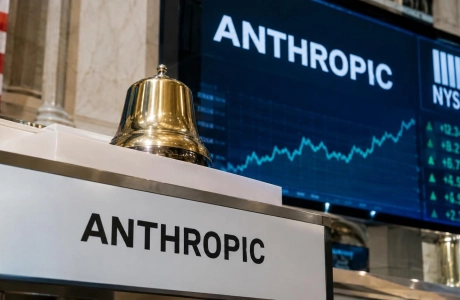
Trading began on November 19 on the Nasdaq, under the ticker ANT, at an offering price of $83 per share. At Friday's close, the stock stood at $88.91, after falling 8.5% that day. The $1.6 trillion valuation does not represent money available to fund research: it is the market value calculated including potential shares.
A record IPO and an enormous computing bill
Anthropic sold 1.103 billion of its own shares, and other shareholders placed nearly 24 million. Of the $93.5 billion in gross proceeds from the public offering, $91.6 billion went to the company; Anthropic did not receive the proceeds from shares sold by those shareholders. Separately, seven companies—including AMD, Google, Microsoft, Nvidia, and TSMC Partners—bought Class N shares for around $26 billion. Total gross proceeds came to $119.5 billion.
That capital provides room to fund infrastructure and operations, but does not by itself solve the economics of the business. The Verge puts projected computing bills for the coming years at around $900 billion. Anthropic rents capacity from major cloud providers and pays for the resources needed to run its models; increased usage can drive revenue, but it also raises demand for capacity and the cost of serving each task.
The IPO page itself presents a picture of rapid growth alongside accounting losses. It also reported a net loss of $23.3 billion, which includes a non-cash charge of $21.9 billion associated with the change in the fair value of financial instruments.
TNW cites another company metric: in the third quarter, Anthropic generated $1.72 in revenue for every dollar spent on computing power, compared with 68 cents a year earlier. This is not a measure of overall profitability: it does not, by itself, include all of the company's expenses or show that its revenue can cover future investments in models and infrastructure.
Safety as a promise and a cost
The tension is not only about whether Anthropic can sell enough tokens above their immediate cost. The Verge argues that the company needs to expand revenue and computing capacity while preserving a commercial identity tied to safe and trustworthy AI. That brand matters especially in its relationships with large customers, which may demand data sovereignty and assurances about how its systems are used.
Turning safety into a commercial advantage means sustaining it when the market demands growth. The Verge warns that some potentially costly safety initiatives could be sidelined if financial pressure increases. It does not claim that Anthropic has already cut those efforts; the risk it identifies is that going public will make the conflict between investing in mitigation and meeting revenue and expansion expectations more visible.
“Anthropic could develop AI systems which become fully autonomous and wipe out humanity which may lead to a serious decline in earnings,”
— Jay Goldberg, analyst at Seaport Research Partners
The statement appeared in an analyst note on November 18 and captures a peculiarity of this new context: an extreme risk tied to the company's purpose is also framed as a potential impact on earnings. Safety is not separate from finance; it now coexists with it in the debate over Anthropic's value and its ability to carry out its mission.
Shareholders do not have the final say, but they do have influence
The governance structure adds a wrinkle. In The Verge conversation, Hayden Field describes a combination of founders and a special trust with decision-making power. According to that analysis, shareholders cannot remove executives through a vote and have limited ability to influence the company. The structure therefore reduces one direct avenue for shareholder pressure, but does not insulate Anthropic from the economic demands of being a publicly traded company.
The valuation sets a public benchmark; investors expect revenue and, eventually, profits to keep pace with growth. The Verge cites an estimate that Anthropic would need to grow its revenue roughly 17-fold over ten years to deliver a return comparable to that of some technology competitors. This is a projection cited in the conversation, not an official company target.
The stock's initial performance also shows that access to the IPO and buying on the market were not equivalent. Some funds that did not receive shares in the offering paid $111.50 at the start of trading, according to TNW, while employees sold more than $25 billion in shares as trading began. Anthropic allowed 10% to be sold on the first day, a decision some investors and analysts considered aggressive.
Model costs change customer decisions
The pressure is not limited to the boardroom. For developers and companies integrating models, the practical question is which tasks justify using a frontier option and which can be handled by cheaper alternatives. The Verge reports that small and medium-sized businesses are creating internal evaluations to distribute the work: reserving some tasks for expensive Anthropic models and routing others to open-source or lower-priced models.
This behavior can make it harder for Anthropic to turn increased usage into a proportional share of revenue. If a company can switch providers or choose a different model for each operation, cost and performance matter alongside trust. The Verge notes that enterprise customers may also ask for portability and data sovereignty, conditions that limit a provider's ability to retain them by making them dependent on its tools.
Anthropic is betting, according to The Verge, on making its products deeply integrated into everyday work and winning enterprise and government contracts. The other bet is that its systems will be valuable enough to justify their price. But the argument that every customer will always need the most powerful model runs up against a specific behavior: assessing which option is “good enough” for each task and saving money on the rest.
The IPO page itself presents examples of this commercial fit: Legora appears in a legal-work use case and says it uses Claude in agentic workflows; Eli Lilly says it gave more than 50,000 employees access to Claude Enterprise. These are examples published by Anthropic, not proof that all customers will maintain the same level of spending or that adoption will automatically translate into growing margins.
A valuation that does not resolve the question
Anthropic's stock performance does not, by itself, prove that the AI bubble will burst or keep inflating. The Verge considers the IPO a reflection of enthusiasm for being the first pure-play AI lab to go public, but says it offers no conclusive answer about the market's sustainability. The stock finished Friday above the $83 offering price, although it gave up some of its initial gains during a week in which the Nasdaq fell 10%, according to TNW.
For Anthropic, the challenge is to turn capital, demand, and trust into an operation capable of paying for costly infrastructure without hollowing out its safety promise. For its customers, the immediate consequence is more concrete: measuring the cost of each task and deciding when Claude is worth the expense compared with another option. The company begins its life as a publicly traded business with extraordinary resources; how much it devotes to growth and how much to reducing risks will be part of the story the market will have to assess.
Sources: TNW | Anthropic, The Verge, Anthropic, Anthropic