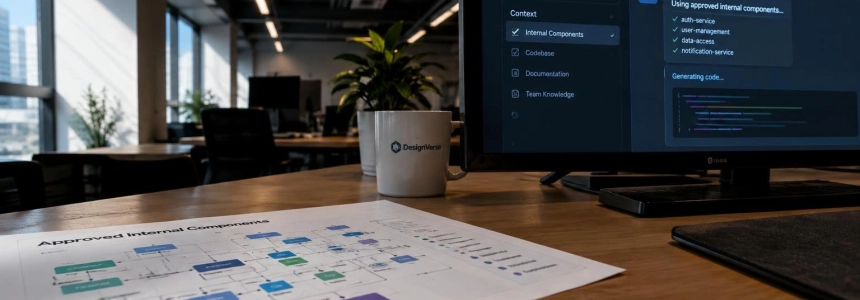
In a test involving 15 enterprise codebases, two coding agents used approved internal components in only 55–59% of tasks. In the remaining tasks, they turned to public alternatives or invented components, according to DesignVerse’s AI Coding Drift Report. Its system, which retrieves project information before each query, reached 92%.
What the test measured and what it left out
The codebases evaluated belong to organizations in aviation, banking, defense, software services, and consulting. Each system had been in use for 15 to 20 years, exceeded one million lines of code, and was maintained by teams of around 20 engineers. Most were written in Ada, C++, or COBOL.
DesignVerse compared two widely used agents, identified as Agent A and Agent B, with its own system. The first two had full access to the repository, but received no custom rules or additional company context. DesignVerse’s system, by contrast, retrieved relevant snippets of code and technical and business documents before each call.
Therefore, the comparison does not isolate the effect of context in the same model: it also compares different tools. Andrei Manolache, DesignVerse co-founder and CEO, acknowledged this difference to TNW: “So this isn’t a comparison of the same model with and without context. It’s a comparison between the typical coding-agent setup available to engineering teams today and a context-engineered alternative”.
The tasks included small refactors, unit tests, and changes spanning multiple systems. There were about ten per codebase, and up to 40 in some cases. Manolache said each represented a change that could take an engineer around 100 hours. The evaluation counted it as a failure if an agent invented an interface or library, or chose a public one when an internal alternative already existed.
Context changes both component selection and repeatability
In addition to component use, the report measured whether agents gave the same answer when a task was repeated. Systems without context did so in 61–69% of runs; DesignVerse’s system did so in 97% of repetitions. Stability can matter for teams that need to review and maintain similar changes, although the figure alone does not prove that every consistent answer is correct.
Another metric compares the tokens read with the code tokens accepted by the team. For agents without context, the median was ten tokens analyzed for every token accepted. In a separate measurement on a client’s system, the ratio reached 150 to one. The report links this difference to the work of reconstructing how the project works and its conventions for each task; it does not present that extreme case as a result from the 15 codebases.
DesignVerse argues that repository access alone does not solve the problem. Standard agents could already consult the code, but they did not have business rules, architectural criteria, or information prepared to guide each task. Its product, also described by Start-up.ro as an Engineering Context Layer, aims to provide this knowledge layer to AI tools.
A savings figure that does not come from the benchmark
The $882,000 that DesignVerse attributes to context comes from a client’s product over 12 months, not from the comparative evaluation. According to Manolache, the work went from nine developers and 9,600 hours to five developers and 4,000 hours: 5,600 fewer hours, a 58% reduction.
The company valued those hours at $157.50, a blended rate derived from a $1.5 million labor invoice. At $120 per hour, the calculation would be about $672,000; at $200, about $1.12 million. The calculation excludes the platform, licenses, tokens, and the cost of building the context layer. Manolache said no one lost their job and that the freed-up hours were allocated to the backlog.
The distinction matters for any company evaluating the investment: the case reflects work capacity reassigned, not a demonstrated reduction in payroll or total spending. Nor can the savings automatically be applied to other teams. Start-up.ro notes that the sum represents the value of time available for other projects, not an actual reduction in labor costs.
“If companies are paying for AI to write code, only to pay their engineers to fix it afterwards, they need to ask some serious questions about the return on that investment,”
— Andrei Manolache, DesignVerse CEO and co-founder
The tension between usefulness, control, and dependence
DesignVerse has a direct commercial interest in the outcome: it sells a context solution, and the 15 participating organizations were already working with the company or evaluating it. Their names were not disclosed because of confidentiality agreements. The company says its teams and the clients’ engineers jointly scored the results, using the same tasks, instructions, tools, time limits, and criteria for each configuration.
Manolache argued that the public methodology makes the conclusions verifiable: “We sell the system, so we have an obvious interest in the outcome. That’s precisely why we made the methodology public and reproducible. We don’t think anyone should have to take our word for it”. The report includes a two-week test that companies can run on their own code and with any model, without hiring DesignVerse. This offers a way to measure the problem internally, although the results of an in-house test will depend on its tasks and criteria.
For companies, the proposal means treating technical context as an asset that must be organized and updated: approved code, architecture, standards, and business rules. This work can make suggestions more relevant, but requires investment in preparing and maintaining the information. DesignVerse’s own financial estimate excludes the cost of building its layer, so it is not a complete accounting of the investment.
There is also a decision about control. Manolache argues that companies in regulated sectors need their own context, to operate under their own control, and to adapt the tool to their way of developing software. He advocates keeping specialized knowledge in an organizational layer and making it possible to change the underlying model. This is a recommendation from the CEO of a company that sells that layer, not an independent conclusion of the benchmark.
Measuring what changed in the code
The report cites Qodo’s State of AI Code Quality 2026: 90% of U.S. engineering leaders said they were confident in their ability to communicate AI’s impact to their boards, but only 45% could link AI activity to the resulting code. The gap points to a specific challenge for companies: attributing outcomes, in addition to counting tool usage.
DesignVerse recommends gathering relevant information and making it available to the agent for each task, applying standards during generation, and keeping records that make it possible to review which rules and data were used. It also proposes assigning someone responsibility for maintaining this information. The practical takeaway from the study is to compare agents using your own tasks and check what accepted code reuses internal components, how much review work it requires, and whether answers remain consistent when tasks are repeated.
The results do not establish that all agents perform equally in every repository: they concern 15 large, long-established systems, and the context-based alternative evaluated was DesignVerse’s product. The two-week test accompanying the report allows other teams to compare these figures against their own modules before extrapolating the savings from a single client.
Sources: TNW | Artificial-intelligence, DesignVerse, Pivot News, Start-up.ro