DuckDB 2.0 is now available, and its own team is asking users not to take it into production just yet. Released on October 21 under the codename Cinnamon Teal, the version is the project's biggest feature update to date, but it introduces a database format that earlier versions cannot read.
In an interview with The New Stack, Gábor Szárnyas, DuckLabs' head of developer relations, repeated the usual warning about .0 releases: «Advice from database folks is that you should never migrate a .0 release in production. So I would like to repeat this warning». The team is already working on 2.0.1, which, according to Szárnyas, will mainly include bug fixes, small performance tweaks and feedback received since the release.
A release focused on new features
DuckDB presented 2.0 as its biggest feature release, more than two years after version 1.0.0. The team puts the work at nearly 20,000 commits since DuckDB 1.5. The release is a long-term support (LTS) version, with maintenance planned at least through October 2027.
DuckDB began as an analytical database that runs inside an application, without requiring a separate server. DuckLabs says users also asked for shared network access; the answer is Quack, a protocol for connecting DuckDB instances, accompanied in 2.0 by the CONNECT statement for directing queries to a remote database.
Hannes Mühleisen, DuckDB co-creator and CEO and co-founder of DuckLabs, summed up the change without presenting the server as a replacement for the original model: «We designed DuckDB so people could analyze data without having to run a database server. Then they kept asking us for a server». The option to run DuckDB inside an application is still available; connecting to a shared instance is an additional option when that model is a better fit.
Quack, remote storage and SQL improvements
Quack takes center stage with performance and stability improvements. DuckDB 1.5.3 introduced the protocol in May; DuckLabs describes that preview as a response to those looking for shared access. In 2.0, one process can serve its databases while another connects, sends queries and receives results. The new CONNECT statement lets users attach to and switch to a remote database.
DuckDB's documentation specifies that the server listens only on localhost by default. To accept connections from other machines, it recommends keeping it on localhost and placing it behind a reverse proxy that terminates TLS; the allow_other_hostname option, which exposes the server directly, is reserved for testing. DuckLabs says Quack is still being refined before it is fully production-ready.
The release also adds asynchronous input/output for reading Parquet, CSV and DuckDB's native format. Read operations can proceed in the background and keep multiple requests in flight, while the I/O layer scales separately from query processing. DuckLabs highlights access to object storage, such as Amazon S3, as one use case that could benefit.
DuckLabs also published a preliminary result from TPC-H decision-support tests at scale factor 1,000: an alpha build of DuckDB 2.0 achieved a composite score approximately 25% higher than DuckDB 1.5.5. The company clarifies that this reflects general engine improvements, not an isolated measurement of asynchronous I/O.
VARIANT reaches full integration for semistructured data, such as JSON with different structures across rows. DuckDB 1.5 had already introduced the type; 2.0 integrates its reading and writing, including Parquet, and can detect common structures to store them in columnar form. The new version also adds NEAREST joins for similarity searches and a range of SQL functions, including JSON modifications and CTEs that can modify data.
Another major change is the extensible SQL parser, which is now enabled by default. The PEG implementation allows extensions to add syntax to the grammar. The documentation notes that the previous parser, derived from PostgreSQL and generated with YACC/Bison, had been part of the project since its first commit in 2018; DuckDB lets users switch back to it with the legacy_parser extension if needed.

Agent Mode and extensions
Agent Mode adapts the CLI for coding agents such as Claude Code, Codex and Cursor. It presents results as compact Markdown tables, reports truncated results, structures errors in JSON and stops runaway queries. The release documentation says that long-running queries report their expected cost before execution, so the agent can decide whether to wait.
In TPC-H experiments published by DuckDB, Agent Mode reduced the amount of output the model had to read by 59%. DuckLabs qualifies this by noting that, in an internal test, the token savings did not substantially reduce the agent's total cost or execution time. Szárnyas described the compact format in The New Stack: «For AI agents, we just print simple Markdown tables in compact mode with no spacing». As he explained, those tables can be between 60% and 70% of their original size and remain readable to the agent.
The release includes a new versioned C API for extensions and allows organizations to host their own repositories of trusted extensions and sign them with their keys. DuckDB warns that the API is not yet marked stable and asks users to test it and send feedback. The repository feature is also still in development, so its syntax may change.
SQL updates include triggers, which can respond to changes in tables, and improvements for maintaining materialized views incrementally. Not all combinations are supported yet: DuckDB lists limitations for certain BEFORE triggers and row-level UPDATE triggers. Core extensions are also getting updates; the team mentions DuckLake 1.1, progress on the Iceberg extension and the creation of Delta tables with partitions and properties.
The change behind the warning
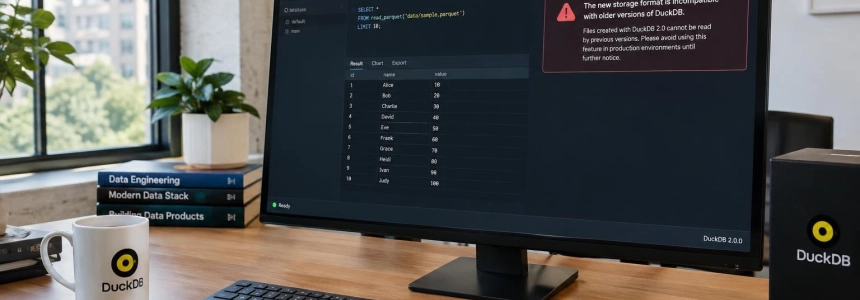
The storage format changes for new files. DuckDB 2.0 writes to storage version v2.0.0 by default, identified as version 69; DuckDB 1.5 uses version 68. Files created in the new format cannot be opened with versions earlier than 2.0. In contrast, DuckDB 2.0 can read and write existing files from previous versions, which remain readable by older versions.
| Storage version | DuckDB versions |
|---|---|
| 69 | 2.0.x |
| 68 | 1.5.x |
| 67 | 1.4.x |
| 66 | 1.3.x |
| 65 | 1.2.x |
| 64 | 0.9.x, 0.10.x, 1.0.0 and 1.1.x |
The new format lazily loads column metadata, which can speed up opening and reduce memory usage in databases with wide tables and large indexes. It also enables DICT_FSST string compression by default, stores row deletions more compactly and strengthens corruption validation.
Migration calls for extra care in deployments with many DuckDB processes, the team warns. The documentation suggests testing 2.0.0 in a mirror system before upgrading. Those who need to maintain compatibility with older versions can create files with an explicit storage version; to move an entire database between formats, DuckDB documents exporting it with the old version and importing it with the new one.
The support window and early testing
DuckDB 1.4 reaches end of support on November 17, 2026, according to the schedule published by the project. DuckDB 1.5 received an extension of support through March 2027, which, according to the team, effectively makes it another LTS version to allow more time for testing and migration. The 2.0 line is supported at least through October 2027.
Early external testing cited in the sources shows both specific use cases and limits to the transition. Plotly tested DuckDB 2.0 in a Dash application with 1.14 billion weather readings, Overture Maps data read from S3 and a week of GitHub events. In that environment, a query on VARIANT data went from 1.5 seconds to 11 milliseconds after the team reorganized how files were written; it also read data for a city from S3 in about four seconds, compared with 12.5 seconds with DuckDB 1.5.6.
Plotly reports that Quack allowed four gunicorn processes to write to a shared database while an hourly job updated it, without losing rows or showing partially updated tables in that test. It also warns of upgrade snags, including the one-way file format and the fact that Quack does not yet accept query parameters. These are results from that application and those tests, not a guarantee for every deployment.
DuckLabs, which develops DuckDB and its associated ecosystem, has operated as an Amazon Web Services subsidiary since September 2026, according to its announcement. The New Stack places Amazon's announcement of its acquisition of DuckLabs in August. AWS has shared that it uses DuckDB internally: its vice president of technology, Mai-Lan Tomsen Bukovec, said the Quick engine, with DuckDB integrations and optimizations, processed more than 2.5 billion queries and helped reduce Amazon Quick's average query latency by 30%.
The next immediate milestone is DuckDB 2.0.1, focused on stabilizing the experience with fixes, small performance changes and user feedback. No date has been announced for that version. In the meantime, the team maintains its recommendation: test 2.0 before moving production workloads, especially when new files or multiple processes sharing data are involved.
Sources: The Capitol Journal, DuckDB, DuckLabs, DuckDB, Plotly