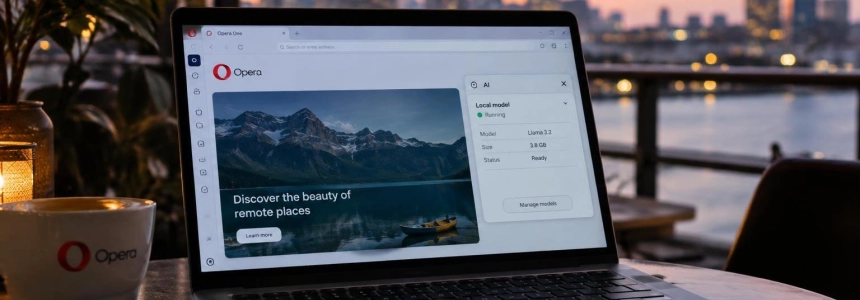
Opera wants websites to be able to use artificial intelligence models that run on the user's computer, instead of sending every request to a cloud service. The company has begun offering WebAI in preview, a proposed web standard that provides access to local models from websites and browser extensions.
The first implementation is available in Opera One. Opera says the system is not tied to a single provider: it can work with open-weight models such as Google's Gemma and, on Macs with Apple silicon, Apple's built-in foundation model. Model availability depends on the platform.
A browser API, with opt-in activation
WebAI is designed to let websites and extensions invoke AI capabilities directly through the browser. These include generating text, classifying content, and detecting relationships between pieces of information. Opera suggested possible uses such as organizing tabs, identifying misleading headlines, or finding relevant job listings.
According to Opera, the proposal is backed by companies such as Google and Microsoft. Its implementation supports various compatible models, with a focus on open models. The company had previously experimented with integrated access to local models in a developer version; now it is bringing the feature to its general-purpose browsers.
The feature is disabled by default: no model is downloaded until the user enables it. Opera also provides for per-site permissions to determine which websites can access local AI. In the preview, WebAI can be enabled in Opera One's settings; the browser then downloads a compatible model.
Opera presents local processing as an alternative for people who do not want to send the content analyzed by AI to an external provider. It also suggests that developers could add AI features without maintaining their own infrastructure or incurring a cost for each query to a remote service. The use of open models does not necessarily mean they are open-source software: TechCrunch notes that these models may have restrictions even when their weights are available.
“A lot of what people want from AI doesn’t need a data center. Your laptop can already do it, without sending your data anywhere,”
— Krystian Kolondra, EVP Browsers and AI, Opera
Performance will depend on the device
The preview is available on 64-bit Windows and Macs with Apple silicon. Opera says it does not work on Macs with Intel processors, Linux, or Windows for Arm. Since the model runs on the device, speed depends on its hardware; the company does not specify a minimum performance requirement in its materials.
Local privacy does not, by itself, eliminate all risks, but it changes where content is processed: on the device rather than on an AI provider's servers. In return, the computer supplies the processing power. Opera acknowledges that performance will vary depending on the hardware, so the same feature may respond differently on different devices.
The company positions WebAI as part of a broader push toward local AI and says it is preparing more models optimized for different devices, as well as tools to make it easier to create web experiences based on them. Opera GX, aimed at gamers and content creators, and Opera Neon, its browser with AI agents, will get WebAI later; Opera has not specified a date.
The announcement also includes HTML-in-Canvas, a separate initiative that lets users place interactive web pages inside two-dimensional or three-dimensional scenes. Its demos, such as Gamer Room and Webpage Bulldozer, work in Opera browsers without configuration. To try WebAI, however, users must enable it and have a compatible device.
Sources: TechCrunch, Opera Newsroom, Opera News, Digital Trends