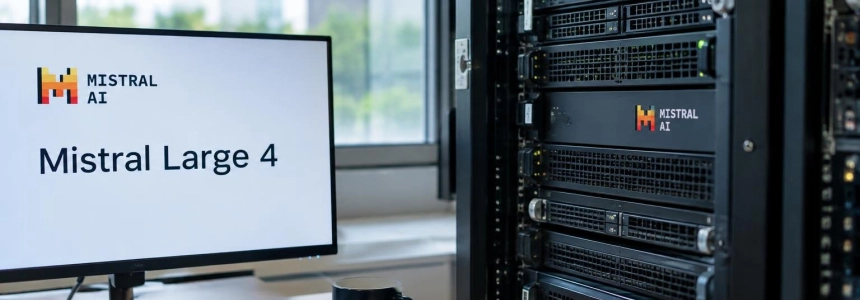
Mistral has released the weights of Large 4, with one trillion parameters, allowing companies and organizations to download the model and run it on their own infrastructure. The France-based company presents this version—nicknamed “Le Chonk”—as a tool for programming and cyber defense. The weights are now available on Hugging Face, and the model is also offered through the Mistral API.
The release follows Mistral’s unveiling of Large 4 in public preview in early October. According to the company, subsequent reinforcement learning and feedback from customers and collaborators improved its programming, cyberattack defense, and reasoning efficiency capabilities. The model is multimodal: it accepts text and images and generates text.
More control, with a risk Mistral is still assessing
Mistral’s central argument is control. By hosting the model on their own systems, organizations can keep their data and operations under their own management rather than relying exclusively on an external service. Pierre Stock, Mistral’s vice president of science, told TechCrunch that access to these capabilities “can’t be cut off by definition because the model is open-weighted”.
“We don’t want to fearmonger people. We think it’s a problem that is solvable. It’s a hard problem to have good security,”
— Pierre Stock, Mistral’s vice president of science
The company says Large 4 can help detect, analyze, and respond to threats in code and IT infrastructure. The defensive tasks it describes include investigating vulnerabilities, reproducing them in an isolated environment, and preparing patches. Mistral says the model scores 51% on the Artificial Analysis Cyber Index, an assessment of vulnerability discovery, reproduction, and remediation.
Making the weights available does not eliminate safeguards. Mistral says Large 4 rejects, on average, 96.6% of malicious cybersecurity-related requests in the tests it cites. Even so, the company says it has detected a possible increase in the model’s ability to carry out attacks in real-world use. Although it observed the model refusing to comply with black-box attack attempts against live targets, it is modifying its protections and expects to continue updating them over the coming months.
For certain advanced uses, Mistral offers selected enterprise partners preview access to a specialized variant designed for penetration testing, vulnerability assessment, and red teaming. The company says access requires a rigorous evaluation and contractual safeguards, and limits testing to systems that are owned or explicitly authorized and to controlled environments. Orange Cyberdefense is among these design partners.
Programming improvements and deployment options
For programming, Mistral highlights a comparison with GLM-5.3, an open-weight model: Large 4 scores 48% on the Artificial Analysis Coding Agent Index, a score the company describes as virtually tied, but uses 47% fewer tokens per task on average. On Terminal-Bench 4.0, which evaluates programming tasks in a terminal, Mistral puts the score at 41%, up from 28% in the preview.
The new version includes three reasoning modes—low, medium, and high—to adjust effort to the type of task. Mistral recommends low for simple tasks, medium for everyday use, and high, enabled by default, for problems that require greater precision. The company says this configuration can help balance performance and inference cost.
Hugging Face describes Large 4 as a mixture-of-experts model with around one trillion total parameters and a one-million-token context window. The platform lists two official variants, FP8 and NVFP4, and notes that the model is distributed under the Mistral Ecosystem Open-Weight license, derived from MIT and with restrictions on model-as-a-service offerings. It also notes that GGUF versions prepared by Unsloth and the llama.cpp team are available.
The availability of the weights does not mean that any computer can run the model without further requirements: self-hosting requires suitable hardware and expertise. Mistral also says customers can adapt the model using their own security data, policies, and detection logic through Mistral Forge; for narrowly defined tasks, it proposes creating smaller, more specialized variants.
Mistral says it is modifying the model’s safeguards and will continue updating them over the coming months. Organizations can already download the weights from Hugging Face or access the model through its API.
Sources: TechCrunch, Mistral, Mistral, Hugging Face, euronews