
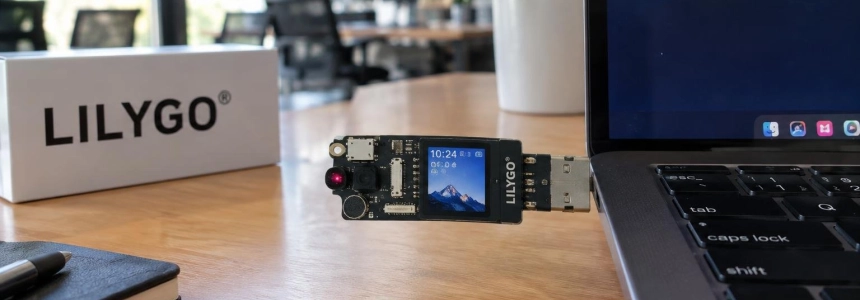
The LILYGO T-Dongle S3 Plus adds a PDM microphone and an infrared emitter to an ESP32-S3 development board that fits inside a transparent USB-stick-shaped case. It can also include an ATECC508A security chip, although this option arrives unconfigured, and some of its settings may be permanently locked when programmed.
The board retains the T-Dongle S3’s 0.96-inch ST7735 display, APA102 RGB LED and TF card slot. It combines 16 MB of Quad-SPI flash, 8 MB of OPI PSRAM and 512 KB of internal SRAM. LinuxGizmos lists a price of $16.71 at LILYGO’s official store.
Audio and infrared in a USB form factor
The PDM microphone provides an audio input connected to GPIO8 and GPIO9. LILYGO’s documentation identifies GPIO9 as the clock and GPIO8 as the data line. This addition allows audio to be captured directly on the board without adding an external microphone; the company presents the component as one of the differences between the Plus version and the standard T-Dongle S3.
The infrared emitter is connected to GPIO7. LILYGO’s product page describes the function as infrared transmission and reception, while the technical documentation and LinuxGizmos specify a transmitter. They do not detail a separate infrared receiver, so transmission is the feature clearly described in those specifications.
The rest of the form factor remains familiar: an integrated USB Type-A connector for connecting, powering and programming the board, a BOOT button and a transparent case. The color display measures 0.96 inches and uses an ST7735 panel connected via SPI, with a resolution of 80 × 160 pixels. An APA102 RGB LED provides programmable visual indication.
For removable storage, the board includes a TF card slot—also referred to as microSD in LinuxGizmos’ information—connected via SDMMC and dedicated GPIO signals. The documentation lists D0 on GPIO14, D1 on GPIO17, D2 on GPIO21, D3 on GPIO18, CLK on GPIO12 and CMD on GPIO16.
The ATECC508A is optional and requires care
Some T-Dongle S3 Plus configurations can include a Microchip ATECC508A. According to LinuxGizmos, the chip provides hardware cryptographic functions such as ECDSA, ECDH and random number generation. LILYGO also lists these capabilities on its product page, along with HA-256 and Secure Boot, although the technical documentation describes the option simply as an I2C security chip.
The component communicates over I2C on GPIO10 and GPIO11: the documentation assigns GPIO10 to SCL and GPIO11 to SDA, and clarifies that these signals apply to the version with the security chip. The Qwiic connector, by contrast, is configured for serial communication by default. To use it as I2C with an external sensor, LILYGO says external pull-up resistors must be added.
The chip does not come ready with a configuration for a specific application. LILYGO explains that at the factory it only checks over I2C that the ATECC508A responds; it does not configure the chip or read or write its contents. Developers must program it according to their needs and understand the settings before changing them, because the component’s configuration can be locked once applied.
This makes choosing the security option a decision to consider before modifying the chip: simply connecting it is not enough to complete the process. LinuxGizmos describes the ATECC508A as a hardware option; LILYGO’s store, meanwhile, lists it in the specifications as a high-security encryption chip. Neither page indicates that it is included in every unit.
Memory and development settings
The ESP32-S3 uses a dual-core Xtensa LX7 processor, according to LinuxGizmos, and wireless connectivity includes 2.4 GHz Wi-Fi 802.11 b/g/n and Bluetooth 5 LE. Memory includes 16 MB of Quad-SPI flash, 8 MB of OPI PSRAM and 512 KB of SRAM. The documentation confirms the capacity of the two external memories and notes that OPI PSRAM must be explicitly selected in the development environment.
LILYGO lists Arduino IDE, PlatformIO and MicroPython as supported platforms. For PlatformIO, its guide instructs users to install Visual Studio Code and PlatformIO IDE, clone the official T-Dongle-S3 repository, select the Plus environment and the example in platformio.ini, then compile before connecting the board and uploading the program.
The guide also provides Arduino IDE settings: ESP32S3 Dev Module board, USB CDC On Boot enabled, CPU at 240 MHz (WiFi), QIO flash mode at 80 MHz, 16 MB flash size, «16M Flash (3MB APP/9.9MB FATFS)» partition scheme, OPI PSRAM, upload speed of 921600 and USB Hardware CDC and JTAG mode. LILYGO’s note emphasizes that OPI PSRAM must be selected to use the 8 MB of memory.
Examples and resources are available in the existing GitHub repository for the T-Dongle S3 series. The documentation says it includes examples for the display, TF card, LED, PDM microphone, infrared and Qwiic, as well as instructions for selecting the Plus environment. It also provides a board schematic.
An evolution of the T-Dongle S3
LILYGO describes the Plus as an upgraded version of the T-Dongle S3: it retains the display, LED, TF slot, Qwiic connector and USB Type-A dongle design, while adding a PDM microphone, IR transmitter and the option to install an I2C security chip.
LinuxGizmos places the model in a product range that also includes the T-Dongle C5, introduced by LILYGO earlier that year. That device uses an ESP32-C5 and supports dual-band Wi-Fi 6. The Plus takes a different approach: it uses an ESP32-S3 with 2.4 GHz Wi-Fi 4 and Bluetooth 5 LE, and adds audio input, infrared and the hardware security option.
The published dimensions are 58 × 18 × 9 mm; LILYGO’s store lists them as 18 × 58 × 9 mm. The documentation specifies a USB input of 4.8 to 5.5 V and a maximum current of 800 mA.
LinuxGizmos lists the price as $16.71 at the official store. LILYGO says it ships internationally and gives estimated delivery times of 7 to 10 business days for DHL and FedEx, 10 to 25 days for Standard Express, and 7 to 15 days for overseas warehouses available in Germany, the United States and Canada. The store warns that delivery times are estimates; it also notes that DHL or FedEx orders require customs clearance and payment of applicable duties.
The unit thus combines a small display, removable storage and three integrated or selectable peripherals—audio, infrared and security—in a USB form factor. For those who choose the ATECC508A, the irreversible configuration of some settings is something to address before putting the chip into service.
Sources: LinuxGizmos.com, LILYGO, LILYGO®, FOSSWire