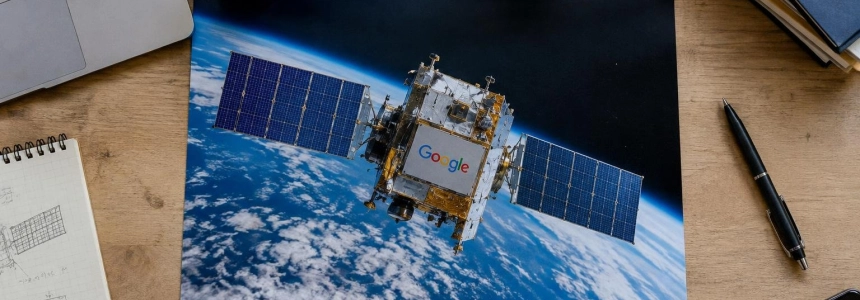
“Blue marble below / Data streams in silent grace / Starlight feeds my core.” That haiku was the first response Google received from its Project Suncatcher prototype satellite, generated in orbit by Gemma 4 with a data-center-class TPU. The company announced the result on October 30: the spacecraft had processed a prompt sent from a ground station and returned the poem as it passed near Svalbard, Norway.
The demonstration is limited in scope and specific in what it verifies. Google managed to run an artificial intelligence inference in space using one of its specialized processors and receive the result on Earth. This does not mean it has launched an orbital data center: the prototype carries four TPUs, but can power up only one at a time and for brief periods. TechCrunch puts that window at about 20 minutes.
Our chips have officially earned their space wings — an important achievement on the long road ahead for this cosmic moonshot.
— Travis Beals, senior director of Paradigms of Intelligence
A response in orbit, after weeks of commissioning
Google launched the satellite on October 1 as part of Project Suncatcher, its research initiative to study whether artificial intelligence computing can be scaled up in space. The mission was carried out in collaboration with Planet and flew on a SpaceX rideshare launch. TechCrunch reports that the Falcon 9 rocket carried more than 100 spacecraft alongside Google’s vehicle.
Before generating the poem, the team spent several weeks completing a commissioning checklist that included powering on the host system and TPU trays and conducting initial machine-learning tests. Google described the first response as its “Hello World” milestone: a message produced by an open Gemma 4 model that had already been loaded onto the satellite.
During a communication window with a ground station, the researchers sent a prompt asking it to write a haiku about being in space. The text arrived as the satellite passed over Svalbard. The team then tested space-themed limericks and requests to check telemetry and the technical status of the payload systems. TechCrunch added that a Google spokesperson described the satellite’s operation as nominal.
The spacecraft generates up to 1 kW of electricity, according to TechCrunch. That figure helps explain why the test remains far from the workloads a network of data centers would require: the TPUs’ power demands limit use to one chip at a time and for short periods. The company presents the satellite as a research prototype, not as operational commercial infrastructure.
The vision: satellites that process data together
Project Suncatcher is exploring a distributed architecture: multiple satellites with processors that communicate with one another through optical links to perform artificial intelligence tasks. Google argues that in low Earth orbit, solar panels could receive nearly constant sunlight and generate up to eight times more energy than equivalent panels on Earth. This is an estimate of a future possibility, not a capability demonstrated by the current prototype.
In September, before the launch, Google explained that future versions could carry dozens of TPUs per satellite and operate in groups. To coordinate processing, each spacecraft would need to know its own position and that of its neighbors, using high-bandwidth laser communications over short distances. The company described the required precision as comparable to hitting a coin from miles away while both points are moving.
The plan announced by Google and reported by TechCrunch sets 2027 for the test of two interconnected satellites. Google describes it as the next milestone in studying how those links work. TechCrunch adds that the spacecraft would allow the team to test greater power generation and optical connections between satellites. The company has not yet demonstrated that such a network can sustain distributed workloads at scale.
TechCrunch distinguishes Suncatcher’s approach from other orbital data center proposals: according to the outlet, Google is betting on links between satellites to share processing, while Starcloud and Cowboy Space plan to run inferences on individual spacecraft. It also notes that SpaceX expects to use laser links, although its satellites would orbit too far apart to share processing effectively.
Radiation, heat, and hardware limits
The next stage of testing will focus on how the TPUs respond to thermal stress and radiation while operating in orbit. The space environment presents problems that differ from those of a terrestrial facility. In a vacuum, there is no air to carry heat away from the processors; Google is therefore investigating combinations of heat pipes and radiators, which it has already tested in a thermal vacuum chamber.
Radiation can also alter circuits. Google said in September that it had tested TPU Trillium with a proton beam at the Crocker Nuclear Laboratory at UC Davis while running artificial intelligence workloads. The company said at the time that initial results indicated the chips could withstand a total ionizing radiation dose greater than what they would receive during a five-year space mission. However, orbital tests are needed to observe hardware behavior under real-world conditions.
TechCrunch explains that a particle can cause a “bit flip”: changing a value stored in memory and corrupting data without necessarily triggering standard monitoring tools. The outlet adds that Google had tested its TPUs in particle accelerators on Earth and that the tests pointed to a smaller impact on inference than on training. The team can now measure these effects on the satellite, rather than relying solely on simulations and laboratory tests.
The Register reports more specific figures from a Google research paper published that month. In laboratory tests, high-bandwidth memory was the component most sensitive to total ionizing dose and showed irregularities after an accumulated dose of 2 krad(Si), about three times the 750 rad(Si) minimum survival threshold required by Google. For typical transformer workloads, the researchers estimated a silent data corruption rate of approximately one event per 17 rad. With an estimated orbital dose of 150 rad(Si) per year and one inference per second, they calculated a failure probability on the order of one inference in three million.
The researchers cited by The Register considered that rate potentially acceptable for inference, but said the effect of single-event effects on training tasks and the effectiveness of system mitigations require further study. The upcoming orbital tests should provide data on actual exposure and sustained chip operation.
The cost of taking computing into space
Abundant solar energy does not, by itself, solve the cost of deploying and maintaining satellites. The Register calculated that the roughly 20 tokens in the haiku would cost around $0.000012 if generated using the Google Cloud API, based on Gemma 4 26B prices of $0.15 per million input tokens and $0.60 per million output tokens, excluding the input cost from that calculation. The expense of launching and operating the satellite is on a different scale, although the outlet’s figures for illustrating it are based on estimates.
For its comparison, The Register assumed a mass of about 500 kg, using SpaceX’s Starlink satellites as a reference, and a retail launch price of about $7,000 per kilogram. Based on Google’s calculations, the outlet said that if the cost of getting a satellite into low Earth orbit fell to $200 per kilogram, the launch cost spread over its service life—estimated at around $810 to $7,500 per kW per year—could approach the electricity costs of terrestrial data centers in the United States, calculated at between $570 and $3,000 per kW per year.
The Register noted that Google believes SpaceX could reach that launch cost by 2035, and that the company sees value in developing prototypes before then. TechCrunch, meanwhile, linked the prospects of both companies to Starship, SpaceX’s heavy-lift reusable rocket, which is still in development and which the outlet says would be necessary to launch its orbital data centers. It also reported that a significant investment by Alphabet, Google’s parent company, in SpaceX ties the two companies together.
The next practical result from Suncatcher will not be another poem, but determining whether the processors can withstand orbital conditions and whether two satellites can maintain an optical connection while working. Google is targeting 2027 for that joint test; until then, Gemma 4’s response confirms an inference in orbit, not the economic viability of a network of space data centers.
Sources: Xataka, Google, TechCrunch, theregister, Google