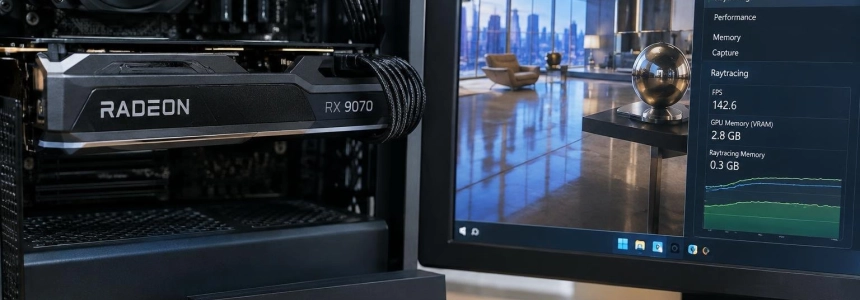
Microsoft measured a drop in ray tracing memory use from 7.5 GB to 774 MB in a test with an AMD Radeon RX 9070. The improvement comes with two new preview features for DirectX Raytracing (DXR): Clustered Geometry and Partitioned TLAS. In the same test, the frame rate rose from 1.2 to 79 fps.
The reduction is close to 90%, but it is not an automatic improvement for every game or graphics card. Microsoft presents the features as part of Agility SDK 1.722-preview, and their availability depends on manufacturers implementing and validating drivers. The company describes them as the biggest DXR update since its debut in 2018.
For DXR this is the most significant update since its debut in 2018.
— Microsoft
Two changes to reduce data updates
Clustered Geometry divides meshes into reusable groups of triangles. Each cluster-level acceleration structure (CLAS) can contain up to 256 triangles and 256 vertices. The application then gathers references to those groups to build a BLAS structure, which is incorporated into the scene's top-level structure.
The idea is to reduce the cost of building large acceleration structures when animation, generated geometry, or objects entering and leaving a scene change. Microsoft says that making these builds more efficient could make it practical to trace rays against the same detailed geometry used for rasterization, rather than resorting to simplified versions. This could make ray-traced shadows and reflections match what is shown on screen more closely.
Partitioned TLAS addresses another bottleneck: updating the structure that represents the entire scene. Instead of rebuilding it completely when only a few objects have changed, it allows instances to be organized into partitions and preserves the structure of groups that have not changed. This lets update work focus on the modified areas.
The two features can be used separately or together. Microsoft also adds a unified API for building and updating these structures from the GPU, with operation inputs that can be generated in video memory. The goal is to reduce both the work needed to maintain geometry and the data that must be reprocessed with each update.
Improvements depend on the game and hardware
The drop from 7.5 GB to 774 MB and the jump from 1.2 to 79 fps come from Microsoft's tests, not from a general measurement across commercial games. PC Gamer cautions that a specialized test environment does not guarantee the same gains in every title.
There is also a cost that development teams will need to consider: working with clustered geometry uses more temporary scratch memory than traditional technology. So, the reduction in ray tracing memory does not eliminate all resource requirements or mean that every implementation will improve to the same extent.
The features do not require new hardware capabilities beyond existing ray tracing support, but that does not mean they are available on every GPU compatible with DXR. Microsoft's table lists support for Radeon RX 9000, Intel Arc B-series and the Intel Core Ultra processors listed in the table, as well as all NVIDIA RTX GPUs. Qualcomm support is listed as planned for 2027. For some GPUs from earlier generations, Microsoft still needs to determine whether implementation is viable.
The comparison with NVIDIA's RTX Mega Geometry helps put the proposal in context: according to PC Gamer, Microsoft's techniques are similar, but their integration into DirectX provides a common path for compatible hardware, rather than limiting the feature to a manufacturer's specific API. Microsoft cites Gears of War: E-Day as an early example of clustered geometry using NVIDIA's own API; standardization in DirectX is intended to make adoption easier in future compatible titles.
A preview is available, but there's no date for players
Agility SDK 1.722-preview is available to developers. Testing these experimental features requires the corresponding preview headers and runtime, a compatible driver, and Windows Developer Mode. Microsoft also provides samples and PIX support for working with the new features.
The DirectX blog is asking for feedback on the design during this phase, ahead of a possible commercial release. Microsoft has not given a date for these features to become generally available in PC games. For now, the most striking figure remains the one from its test with the Radeon RX 9070; the real-world impact will depend on drivers and how studios integrate the technology.
Sources: PC Gamer, DirectX Developer Blog, DirectX Developer Blog, GitHub